
Hospital‑acquired pressure injuries (HAPIs) represent a significant quality and safety concern in high‑acuity environments, particularly within units that manage medically complex, low‑mobility populations. At large city hospitals, where patient turnover is high and clinical teams frequently navigate tight time constraints, the risk of skin breakdown is amplified by traditional workflows that depend on multiple transfers between surfaces. Each of these transitions introduces friction and shear forces that compromise tissue integrity—especially for patients who are already vulnerable due to immobility, pain, or critical illness.
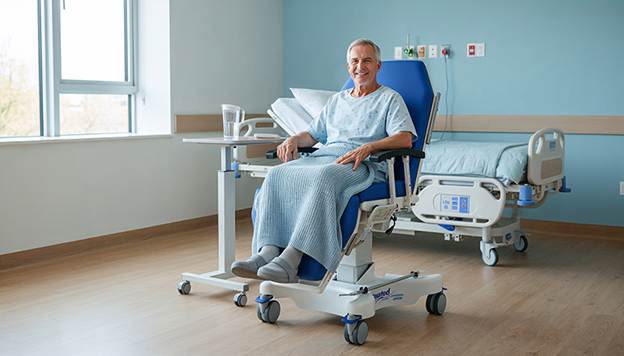
The EPC500’s single‑platform model offers a meaningful reduction in these risks by limiting the number of times a patient must be physically moved throughout their care episode. By keeping the patient on one stable surface from intake through many procedural and imaging events, staff can maintain consistent positioning and reduce exposure to the mechanical stresses associated with unnecessary transfers. This continuity not only supports the technical components of HAPI prevention but also improves the broader care experience, allowing repositioning and mobility interventions to occur with greater ease and frequency.
In one study, staff feedback reinforced how the EPC500 contributed to improved mobility practices across units, noting that repositioning was quicker, safer, and required fewer personnel. These gains are especially relevant as hospitals integrate the EPC500 into its standardized training pathways, including mandatory HAPI‑prevention education. Embedding the chair into existing mobility and skin‑integrity initiatives ensures that staff are not only familiar with the equipment but also understand how a streamlined platform directly supports evidence‑based prevention strategies.
“Many of them (staff) reflected on how mobility was increased in their Units by several 100 percents! Your chairs played a major role in enabling that positive change. In 2026, the Crit Care Team would love to partner with you to celebrate past mobility improvements while encouraging them to continue. Education towards your chair continues for both new employees and in a mandatory HAPI prevention class.”
—Staff from a large city hospital.

By reducing transfers, supporting easier repositioning, and aligning with the hospital’s HAPI‑prevention curriculum, the EPC500 becomes more than an operational improvement—it functions as an active contributor to patient safety outcomes. This creates a natural alignment between unit‑level performance goals, mobility expectations, and the broader institutional focus on high‑reliability care.
Learn more here: Hausted EPC500 Powered Procedure Chair